Editors’ Note:
Yishu 105 is the third of our annual thematic issues. The current issue includes essays on both historical and contemporary intersections over the past century between Asian artists and artists from other regions of the art world. These connections navigate various social and political moments, as well as recognize influences that have both entered and exited Asia. As exemplified in several previous issues of Yishu, looking beyond China serves to position it within a broader shared international context.
Yishu 105 opens with essays by Jinyoung Anna Jin, Marisol Villela Balderrama, Zheng Shengtian, and Renato González-Mello arising from the 2025 symposium Art, War, and Revolution: Lee Qoede and the Global Currents of Muralism in Asia. All four texts address the significance of Mexican muralism upon artists, intellectuals, and activists in China, Korea, Japan, and India. This little-known facet of early and mid-twentieth century Asian art uncovers noteworthy histories that have been largely overlooked.
These essays are followed by Cai Tao’s corresponding exploration of what is one of the earliest political murals in China painted in Wuhan in 1938 and proposes that the spirit of Diego Rivera may be embedded in its conception. The idea of intersections continues with Phyllis Hanyang Zhong’s essay on the significant impact of Chinese artist Teng Baiye on Mark Tobey’s painting and its distinctive contribution to American Abstract art in the mid-twentieth century.
Stephanie Bailey’s text on the divisions of class and race demonstrated in the exhibition The Great Camouflage provides a segue between histories of social and political campaigns that are addressed in the content of the artwork and the contemporary perspectives employed to reconsider them. Transitioning into institutional exchange, Julie Chun assesses the influence of non-Chinese institutions on Shanghai’s contemporary cultural scene.
Martina Köppel-Yang details a shift in the work of Chinese artists who settled in Paris in the 1980s and 90s and who combined traditional Chinese concepts with an international vision to that of a new generation of artists who sidestep such traditions to imagine themselves within a larger world context. Luna Huang Roumin builds upon this in speaking to diasporic experience, one where cultures collide and the idea of “Chinese” artist assumes new meaning.
To conclude, Viela Hu takes us on a journey into a world where she proposes Matthew Wong as one of a younger alliance of artists who are transnational, and, in effect, borderless. Taken together, the essays in this issue underscore how artistic exchange across borders, ideologies, and generations has continually reshaped the ways in which art is made, read, and situated within an expanded art history.
Diana Freundl, Keith Wallace, Zheng Shengtian, Editors
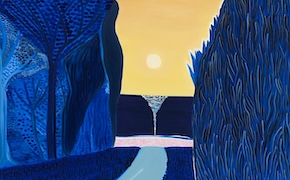
Image Caption: Matthew Wong, A Dream (detail), 2019, oil on canvas, 177.8 × 203.2 cm. © The Matthew Wong Foundation / CARCC Ottawa 2025.